EGC vs EBJ: How to Size Equipment Grounds and Bonding Jumpers in the Box
A working electrician's guide to equipment grounding conductors versus equipment bonding jumpers, and how the 2023 NEC changes tying grounds in the box.
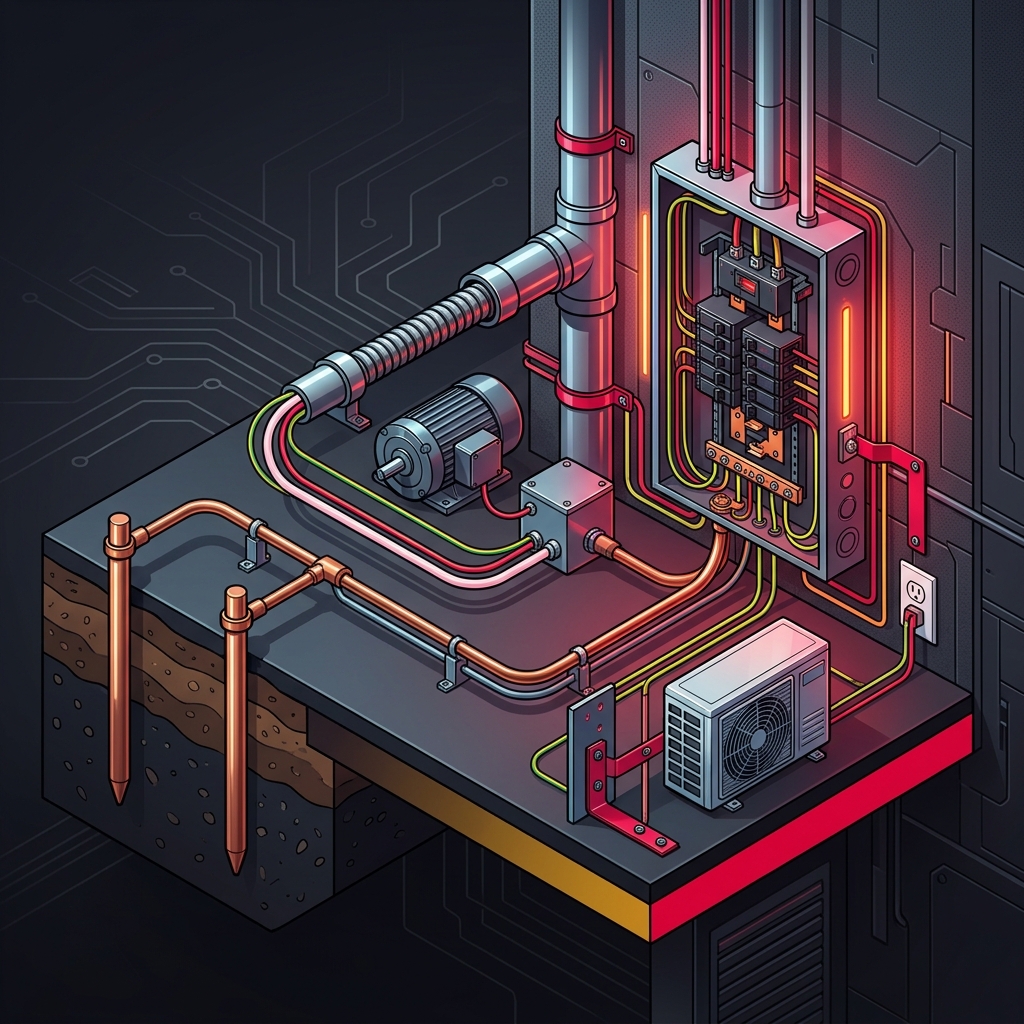
EGC vs EBJ: Same Wire, Different Job
One of the most common sources of confusion on the job — and on social media — is the difference between an equipment grounding conductor (EGC) and an equipment bonding jumper (EBJ). They’re often the same physical wire, the same gauge, the same colour. But they do different jobs, and the NEC sizes them under different rules.
This came up after a video showing a box with both 14-gauge and 12-gauge circuits set off a heated debate. Let’s clear it up the way a mentor would on the truck — with the code references to back it up.
First, the 2023 Change: Tie All the Grounds Together
Before we get into the EGC-versus-EBJ question, there’s a foundational point that kicked off the whole discussion.
“In the past if you separated in a box and had your 12s on one side and your 14s on the other and you didn’t tie the equipment grounds together, probably you would never have an issue… but we’re talking about the 2023 and now it’s required that you tie them all together.”
For eons, plenty of electricians ran separate grounds in the same box and never saw a problem. But the 2023 NEC has clarified that all equipment grounding conductors in a box must be tied together. The takeaway:
- On the 2023 code, splicing all the grounds together is required, not optional.
- Even if your jurisdiction is still on the 2017 or 2020 NEC, it’s smart practice to do it anyway.
- It mirrors what you already do at the panel — every ground lands on the same bus bar, so why treat the box any differently?
When the code panels elaborate on something, that’s a signal to learn from it and adjust your habit. The practical move going forward: bring all the equipment grounds together, every time.
When It’s an EGC — and When It Becomes an EBJ
Here’s where the semantics matter. The distinction comes down to whether the conductor is connecting two things or simply being extended.
Scenario 1 — Single cable, no splice = EGC
Picture a nail-up box with a single 14/2 cable coming in. You carry the bare ground straight over to the device’s grounding screw. There’s no splice, no junction of two separate conductors.
“That is still an equipment grounding conductor. You just didn’t splice it. It wasn’t a jumper. It wasn’t connecting two components… it was the equipment ground. It’s just extended to the device.”
No splice, no bonding jumper. It’s still the EGC — just carried to the device.
Scenario 2 — Splice with a pigtail = EBJ
Now picture a two-gang box where you’re splicing your grounds together. You twist all the EGCs in a wire nut and run a pigtail over to the device’s grounding screw.
“Now you have, in my opinion, you’re interconnecting the EGC with a piece of equipment — in this case the device — and so that becomes an equipment bonding jumper.”
That pigtail is interconnecting the grounding system to a piece of equipment. By definition, that’s an equipment bonding jumper.
How to Size the Equipment Bonding Jumper
This is exactly where the online argument went sideways. The claim under dispute was: if a box has both 12-gauge and 14-gauge circuits, the jumper to a 14-gauge switch has to be upsized to 12 gauge.
That’s just not true. Here’s the correct chain:
- Equipment bonding jumpers are sized under 250.102(D).
- That section ultimately sends you to 250.122.
- And 250.122(A) tells you the bonding jumper never has to be larger than the circuit conductors supplying the equipment.
So if a 14-gauge circuit feeds the switch, you use a 14-gauge equipment bonding jumper. Full stop.
The logic is plain common sense once you trace the circuit:
“The circuit itself that’s supplying power to that switch is 14 gauge all the way back to the panel, all the way back to the circuit breaker or fuse. That is your equipment grounding conductor.”
The EGC running back to the panel is only 14 gauge. Why on earth would you upsize the little jumper from the splice to the device to 12 gauge, when the entire grounding path feeding it is 14? You wouldn’t. There’s no code basis for it and no practical reason for it.
Don’t Confuse This with 250.148(C)
The other point that kept getting dragged into the argument was 250.148(C) — and it simply doesn’t apply to the device jumper.
“Somebody keeps bringing up 250.148(C). That only applies to the jumper or the connection to the metal box… that has nothing to do with the jumper over to the switch.”
Here’s the clean separation:
- 250.148(C) governs the bonding jumper from your EGCs to the metal box itself. If you had a 20-amp and a 15-amp circuit landing in that metal box, you’d size that box bonding jumper off the larger circuit — the 20-amp.
- The jumper from the splice over to the switch is a different animal. It’s governed by 250.102(D)/250.122, and it doesn’t have to be larger than the conductors supplying the switch.
If you were bonding a metal box, the box-bonding discussion would be fair game. But that’s not the question here — so 250.148(C) is irrelevant to sizing the device jumper. (It’s also not relevant to a plastic box, which would fall under 250.148(D) anyway.)
A Box Brain-Teaser to Sleep On
Here’s a scenario worth thinking through. Say you’ve got a 12/2 and a 14/2 non-metallic sheathed cable entering a metal box, and you want to wrap a ground around the box’s grounding screw before heading to the splice.
- Wrap the 14-gauge around the box screw, then run it to the splice → violation of 250.148(C). You’re bonding the metal box with a 14-gauge conductor when a larger circuit (12-gauge) is present, so the box bonding jumper is undersized.
- Wrap the 12-gauge around the box screw, then carry it to the splice where all the 14s and 12s connect → compliant with 250.148(C). The box is now bonded by the largest conductor in the box.
“Those are just things to think about, folks. I’m going to let you sleep on that one.”
Small detail, big difference — and it’s exactly the kind of nuance an exam loves to test.
The Bottom Line
- EGC vs EBJ is about the role, not the wire. A ground extended to a device with no splice is still an EGC. A pigtail spliced over to equipment is an equipment bonding jumper.
- Tie all grounds together — required by the 2023 NEC, smart practice on any edition.
- Size the device bonding jumper under 250.102(D) → 250.122; per 250.122(A) it never has to exceed the circuit conductors feeding the equipment.
- 250.148(C) is for bonding the metal box, sized off the largest circuit — not for the jumper to the device.
How NEC Mastery Fits Into This
Grounding and bonding is the single most argued-about topic in the trade — and as this debate shows, even experienced electricians trip over EGC-versus-EBJ sizing. The fix isn’t memorising one answer; it’s drilling the code chain until the navigation becomes second nature. That’s where NEC Mastery comes in.
- 8,000+ exam-style questions let you practise grounding and bonding scenarios — boxes with mixed conductor sizes, pigtails, metal versus non-metallic boxes — until 250.102(D), 250.122 and 250.148 sizing rules are automatic.
- Detailed explanations referencing specific NEC articles walk you through exactly why a 14-gauge jumper is correct and which section governs it, building the mental map of Article 250 that keeps you from getting dragged into the wrong code reference.
- Timed mock exams weighted to your exam type rehearse these distinctions under pressure, so when a question hinges on EGC versus EBJ — or whether 250.148(C) even applies — you answer with confidence instead of guessing.
Learn the structure of the grounding rules through practice, and the social-media arguments stop being confusing — because you’ll already know exactly where the code sends you.
Start Practising Today
Download the NEC Mastery app and study with 8,000+ practice questions, weighted mock exams, and detailed explanations.