Multiwire Branch Circuits: How to Wire Them Safely Under the NEC
A clear, code-based guide to multiwire branch circuits: what they are, how to install them properly, and how to avoid mistakes that burn up neutrals.
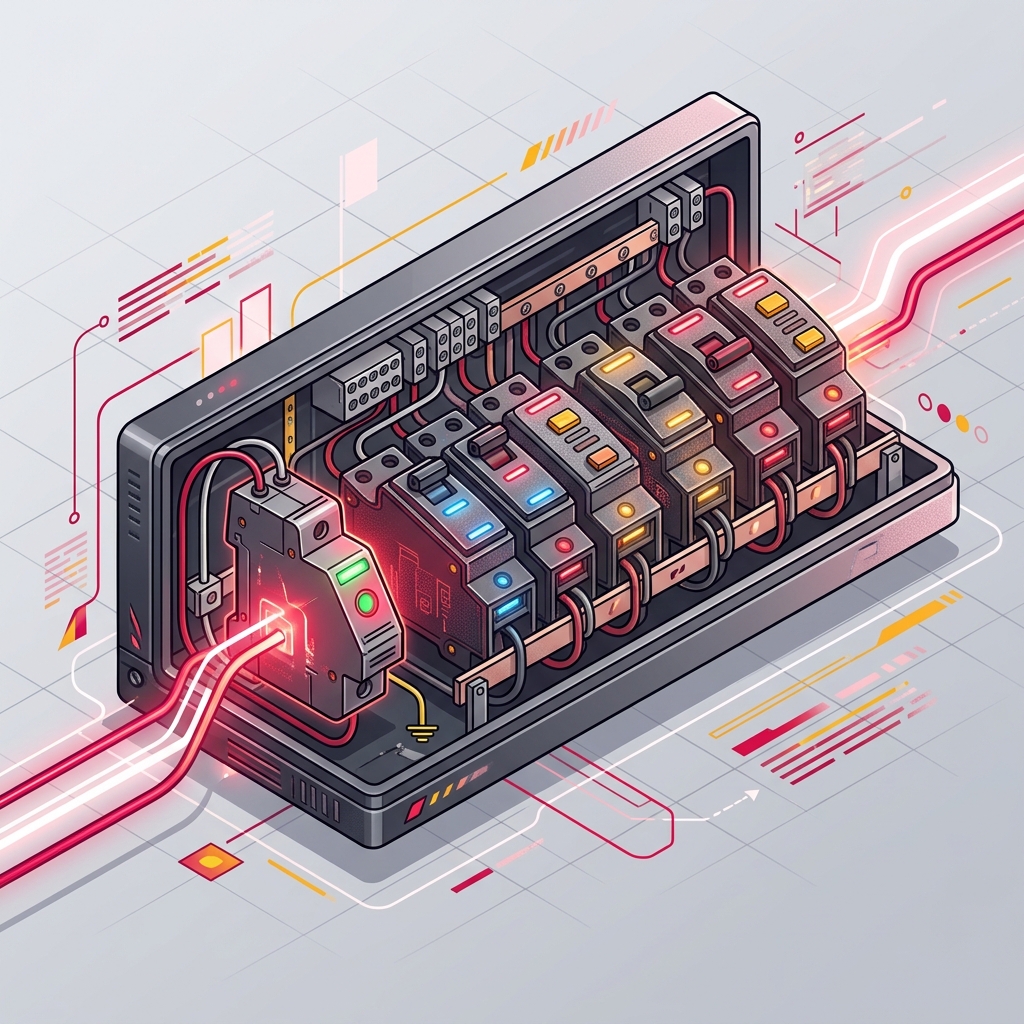
What a Multiwire Branch Circuit Actually Is
A multiwire branch circuit (MWBC) is one of the most misunderstood wiring methods in the NEC. Some electricians avoid them entirely, others use them every day without issue. The difference comes down to whether you understand how the shared neutral behaves — and how to install the overcurrent protection correctly.
Per Article 100, a multiwire branch circuit is defined as:
“A branch circuit that consists of two or more ungrounded conductors that have a voltage between them, and a neutral conductor that has an equal voltage between it and each ungrounded conductor of the circuit and that is connected to the neutral conductor of the system.”
In residential terms, that’s typically a 12/3 or 14/3 NM cable — a black, a red, a white, and an equipment ground. You’re getting two separate 120V circuits out of a single cable assembly by sharing the neutral. It is not one circuit. It is two (or three, in a three-phase application).
The Cancellation Effect: Why a Shared Neutral Is Safe
The fear around MWBCs usually comes from a misunderstanding of how the neutral loads up. Here’s what actually happens when the circuit is installed correctly with the two ungrounded conductors on opposite legs:
- 20A on the red, 20A on the black → neutral carries 0A (full cancellation)
- 10A on the red, 5A on the black → neutral carries 5A (the imbalance)
- 20A on the red, 0A on the black → neutral carries 20A (maximum imbalance)
The neutral can never carry more than the rating of either ungrounded conductor, because the two legs are 180° out of phase on a single-phase system. The sinusoidal waveforms cancel.
But install both single-pole breakers on the same leg and the math flips. Now the currents are additive. 10A on each circuit means 20A on the neutral. Push that to 20A on each circuit and your #12 neutral is trying to carry 40A — double the 20A that circuit is protected at, and well past the ampacity of the conductor. That’s how you burn up neutrals and start fires.
NEC 210.4: The Rules for Multiwire Branch Circuits
Section 210.4 governs MWBCs. Four requirements you cannot skip:
- 210.4(A) General — All conductors of an MWBC must originate from the same panelboard or distribution equipment. You cannot pull legs from two different panels.
- 210.4(B) Disconnecting Means — Each MWBC shall be provided with a means to simultaneously disconnect all ungrounded conductors at the point where the branch circuit originates.
- 210.4(C) Line-to-Neutral Loads — MWBCs shall supply only line-to-neutral loads, with two exceptions: (1) when the MWBC supplies only one piece of utilization equipment, or (2) when all ungrounded conductors are opened simultaneously by the branch-circuit overcurrent device.
- 210.4(D) Grouping — The ungrounded and grounded conductors of each MWBC shall be grouped (per 200.4(B)) at the point of origination — typically with a tie wrap — unless the grouping is obvious (such as a cable assembly).
Identified Handle Ties: Do It Right
NEC 240.15(B)(1) allows individual single-pole breakers with identified handle ties to protect each ungrounded conductor of an MWBC serving line-to-neutral loads. The key word is identified — a manufacturer-listed handle tie designed for that breaker.
What does not qualify:
- A piece of copper wire wrapped between handles
- A 6-32 screw and nut through the handle holes
- A tie wrap or zip tie
- A nail
“A 6-32 with a screw through it, a piece of wire, a tie wrap, a nail — all those things are not identified as a handle tie. So the answer is no bueno.”
For line-to-line loads on single-phase per 240.15(B)(2), the single-pole breakers themselves must be rated 120/240V. A standard 120V single-pole can only be used with another single-pole and a handle tie for line-to-neutral loads. The simplest, foolproof option is just a two-pole breaker — common trip, simultaneous disconnect, no ambiguity.
NEC 300.13(B): Never Let the Device Be the Neutral Splice
This is the single most important rule for anyone running MWBCs in a commercial environment — but it applies anywhere.
NEC 300.13(B) says the continuity of the grounded conductor of a multiwire branch circuit shall not depend on device connections (receptacles, lamp holders, etc.) where the removal of such device would interrupt the continuity.
Why it matters: imagine a 12/3 MWBC feeding two duplex receptacles. If you wire the neutral into the device terminal and back out, the neutral’s continuity depends on that receptacle staying in place. Pull the receptacle to swap it out and:
- Two 120V circuits sharing the neutral now see each other in series
- The loads downstream become a 240V loop
- Equipment that was never rated for 240V — electronics, motors, ballasts — burns up
The fix is simple. Splice the neutrals together inside the box with a wire nut and pigtail to the device. Removing the device leaves the neutral splice intact for everything downstream.
A Real-World Application
A classic example from the field: small dwelling unit kitchens at a university. The countertop area required two small-appliance branch circuits per 210.52(B), but the run was tight.
The solution: a single 12/3 NM cable feeding one duplex receptacle. Break the brass tab between the hot terminals (leaving the neutral tab intact), land the red on top and the black on bottom. One cable, two small-appliance circuits, code-compliant — provided the breakers are stacked on opposite legs with a handle tie or two-pole.
The Bottom Line
Multiwire branch circuits are not dangerous. Improper installation is dangerous. Follow the rules and they’re one of the most efficient wiring methods available:
- Originate from the same panel — 210.4(A)
- Opposite legs, simultaneous disconnect — 210.4(B) and 240.15(B)
- Identified handle tie or two-pole breaker — never a screw, wire, or tie wrap
- Group conductors at the panel — 210.4(D) when not obvious
- Pigtail neutrals at devices — 300.13(B)
- Run all conductors of the MWBC together — 300.3(B)
Get those six things right and you can wire MWBCs every day with zero risk.
How NEC Mastery Fits Into This
Multiwire branch circuits are the kind of topic that shows up on every journeyman and master exam — and they’re the kind of topic that gets electricians in real-world trouble when they skip the details. NEC Mastery is built to drill those details until they’re second nature:
- 8,000+ exam-style questions covering Article 210, 240, 300, and the rest of the code chapters where MWBC rules live — repeat the questions until the cancellation math, handle-tie rules, and 300.13(B) splice requirement become automatic
- Detailed explanations referencing specific NEC sections like 210.4(B), 240.15(B)(1), and 300.13(B) so every wrong answer becomes a code-lookup lesson, not just a memorised fact
- Timed mock exams weighted to your exam type that mix MWBC questions in with the rest of the code, training you to identify the topic and find the answer under exam-day pressure
- Practise wherever you are — whether you’re studying for the test or just want to sharpen your code knowledge between jobs, the questions are always one tap away
Master the rules in the codebook, then prove you know them with the questions. That’s how you pass the exam and wire it right in the field.
Start Practising Today
Download the NEC Mastery app and study with 8,000+ practice questions, weighted mock exams, and detailed explanations.