AC Cable Explained – A Working Electrician's Guide to Article 320
A practical breakdown of NEC Article 320 armoured cable: how Type AC differs from MC, where you can run it, and the bonding strip and ampacity rules.
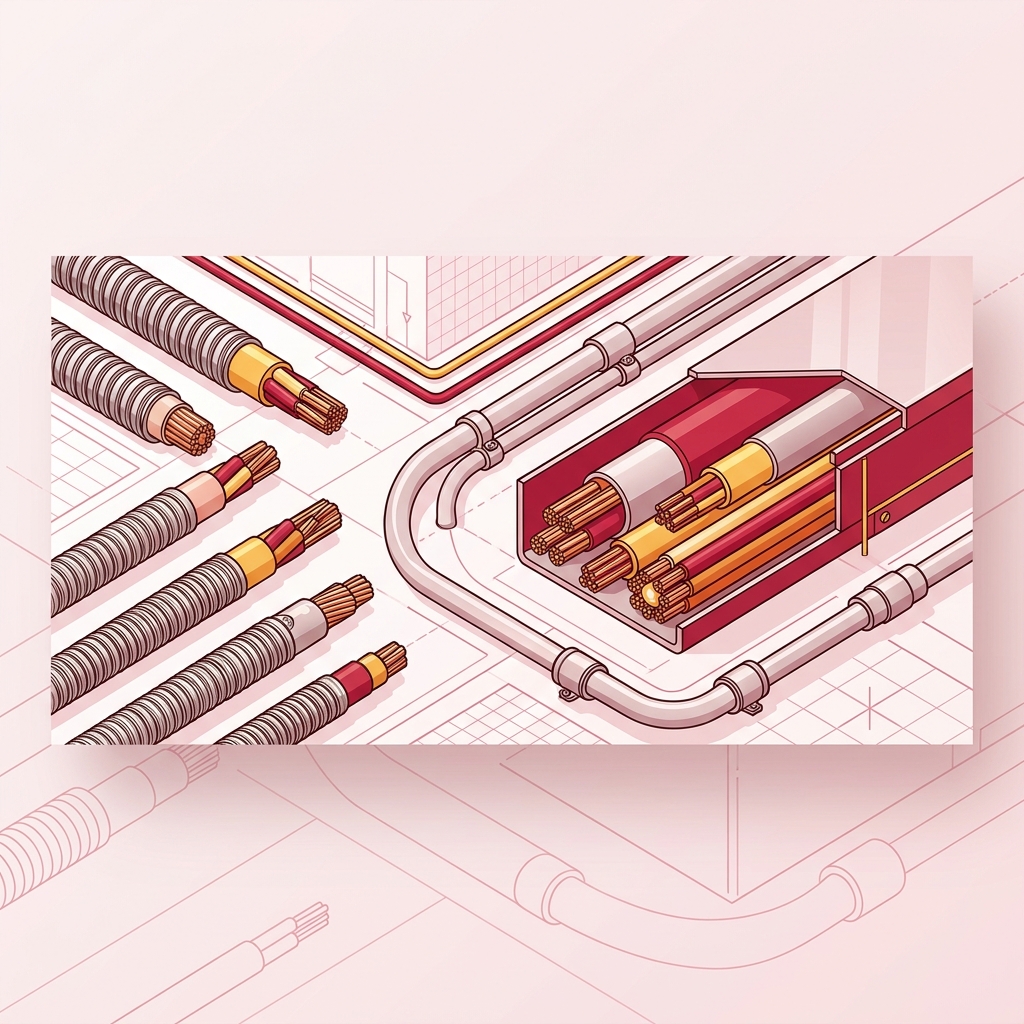
The Old Cousin of MC Cable
If you have spent any time pulling wire, you have run metal-clad cable. But its older, original cousin — Type AC armoured cable, covered by Article 320 — gets overlooked far too often. As Paul Abernathy of Master The NEC put it in a recent Coffee Hour session, AC cable is “the original smart cable” because the armour itself can be used as an equipment grounding conductor.
Article 320 is organised the same way as the other wiring-method articles: Part I covers installation, Part II covers construction, and Part III covers the conductors. The scope makes clear we are talking about Type AC cable specifically — a UL 4 product, not the UL 1569 metal-clad cable that people so often confuse it with.
AC vs MC: The Difference That Actually Matters
Here is the distinction worth tattooing on your brain:
- Type AC cable (UL 4) has an internal bonding strip — copper or aluminium — in intimate contact with the armour for its entire length. That bonding makes the armour a recognised equipment grounding conductor under 250.118.
- Type MC cable (UL 1569) does not. Its armour cannot serve as the equipment ground unless you step up to a “smart ground” product (sometimes called MC-AP), which runs a larger aluminium conductor against all the metal.
“I don’t know why when you’re dealing with 20 amp circuits and 15 amp circuits and traditional, I don’t know why more people don’t use AC cable.”
The practical upside is labour. With AC cable, as long as you use listed fittings into a metal box, everything is bonded — you have an effective ground-fault current path with no separate equipment ground to land and no jumpers to make. AC cable is also limited by UL 4 to conductors no larger than 1 AWG, which is part of why it is not listed for service use under Article 230.
And BX Is Not Either of Them
A quick myth-buster: when someone says “BX,” they are using a term for a product that stopped being made decades ago. Old BX has paper inside and a dark grey armour that was never evaluated as an equipment ground.
“BX you could never use the armour ever as an equipment ground. Was never evaluated for it.”
The reason matters. The spiral armour of old BX creates a choke effect — the expanding and collapsing magnetic fields add so much impedance that fault current cannot clear the breaker. Paul described a real call where improperly grounded BX arced across its convolutions and charred the wood studs it ran through. AC cable solved this precisely with that internal bonding strip, which lets fault current jump across the convolutions instead of spiralling.
Where You Can — and Can’t — Run It
Uses permitted (320.10): feeder and branch-circuit work, exposed and concealed, in cable trays, embedded in plaster finish on brick or masonry, and fished into the air voids of masonry block or tile walls. Notice there is nothing about service — that is by design.
The uses-permitted list carries an informational note that it is not an all-inclusive list. This is the single most useful tidbit in the article:
“If you have a location or an application that’s not under the uses permitted, but it’s not clearly restricted under the uses not permitted, then it is fair game.”
That is why you can run AC cable in a raceway even though raceways are not listed — it is not prohibited.
Uses not permitted (320.12): locations subject to physical damage, damp or wet locations, exposure to corrosive conditions, and embedment in damp/wet plaster or masonry. AC cable is strictly a dry-location product — it has no jacketing option and you cannot buy a PVC-jacketed version (that is an MC product). The corrosive-condition prohibition makes sense once you remember you are relying on the armour as your fault path: corrode the armour and you lose your effective ground-fault current path.
Remember too that “subject to physical damage” is not a defined term — it is deliberately subjective so the AHJ and installer can apply common sense.
Support, Securing, and the Attic Rules
For securing and supporting, AC cable mirrors NM cable nicely:
- Secure within 12 inches of every box, cabinet, or fitting (320.30).
- Secure and support at intervals not exceeding 4½ feet.
- Horizontal runs through wood or metal framing members are considered supported and secured where the supports do not exceed 4½ feet — but the moment the cable turns vertical out of the framing, the securing requirements kick back in.
For exposed work (320.15) and runs through or parallel to framing members, you are sent to 300.4 for bored-hole and parallel-run protection. Grommets are not required for AC or MC through metal studs (unlike NM).
In accessible attics (320.23), note the power of “and” — you follow A and B where both apply:
- Across the top of framing members within 7 feet of the access, protect with guard strips at least as high as the cable.
- Where the space is reached only by a portable ladder through a scuttle hole, protection is required only within 6 feet of the opening.
- Run parallel to the sides of framing members, and neither guard strips nor running boards are required — just keep it back per 300.4.
Unsupported cable (320.30(D)) is permitted when fished in finished buildings, when not more than 2 feet is needed for flexibility at terminals, or not more than 6 feet from the last support to a luminaire in an accessible ceiling.
Anti-Short Bushings, Bending, and Ampacity
This is where AC cable diverges sharply from MC. 320.40 requires, at every point where the armour terminates, both abrasion protection and — read the “and” carefully:
“And in addition, an insulating bushing or its equivalent protection shall be provided between the conductors and the armour.”
That insulating bushing is the red head (anti-short bushing), and it must remain visible for inspection — hence the little sight hole in AC connectors. UL 4 actually requires the manufacturer to ship them: a minimum of 35 anti-short bushings with every 250-foot coil. MC cable (UL 1569) does not mention them at all, which is why they are optional there.
A few more numbers to lock in:
- Bending radius (320.24): the inner edge of the bend shall be no less than 5 times the cable diameter (MC is 7 times).
- Ampacity (320.80): follows 310.14, subject to adjustment and correction under 310.15. Where AC cable is installed in thermal insulation, conductors must be rated 90°C for adjustment purposes, but the ampacity shall not exceed the 60°C column — just like NM cable.
- Bundling: under 310.15(C)(1)(d), you can skip the adjustment factor for AC/MC with no overall jacket, not more than three current-carrying conductors, 12 AWG, and not more than 20 current-carrying conductors bundled without spacing. Exceed 20 and the exception applies a 60% adjustment.
When you reach the internal bonding strip at the box, its job is done — fold it into the convolutions or snip it off. You never terminate it.
How NEC Mastery Fits Into This
Article 320 is a perfect example of why exam success comes down to navigating the code, not memorising it — the power of “and” in 320.40, the not-all-inclusive note in 320.10, the 5× bend radius in 320.24, and the 90°C/60°C ampacity dance in 320.80 all live in different sections that questions love to combine. That is exactly the skill NEC Mastery builds:
- 8,000+ exam-style questions give you endless repetition on wiring methods like AC and MC cable, so the distinctions become second nature.
- Detailed explanations referencing specific NEC articles — 250.118, 300.4, 310.15(C)(1), 320.30 — reinforce where each rule lives, building the mental map that lets you find answers under time pressure.
- Timed mock exams weighted to your exam type let you practise spotting the subtle “and/or” traps and ampacity adjustments before they cost you points on test day.
Learn the structure, practise relentlessly, and Article 320 stops being intimidating and starts being routine.
Start Practising Today
Download the NEC Mastery app and study with 8,000+ practice questions, weighted mock exams, and detailed explanations.