Pool Bonding 101 – Understanding Equipotential Bonding for Permanently Installed Pools
A practical guide to equipotential bonding for permanently installed pools: what must be bonded, bonding methods, and key NEC 680.26 requirements.
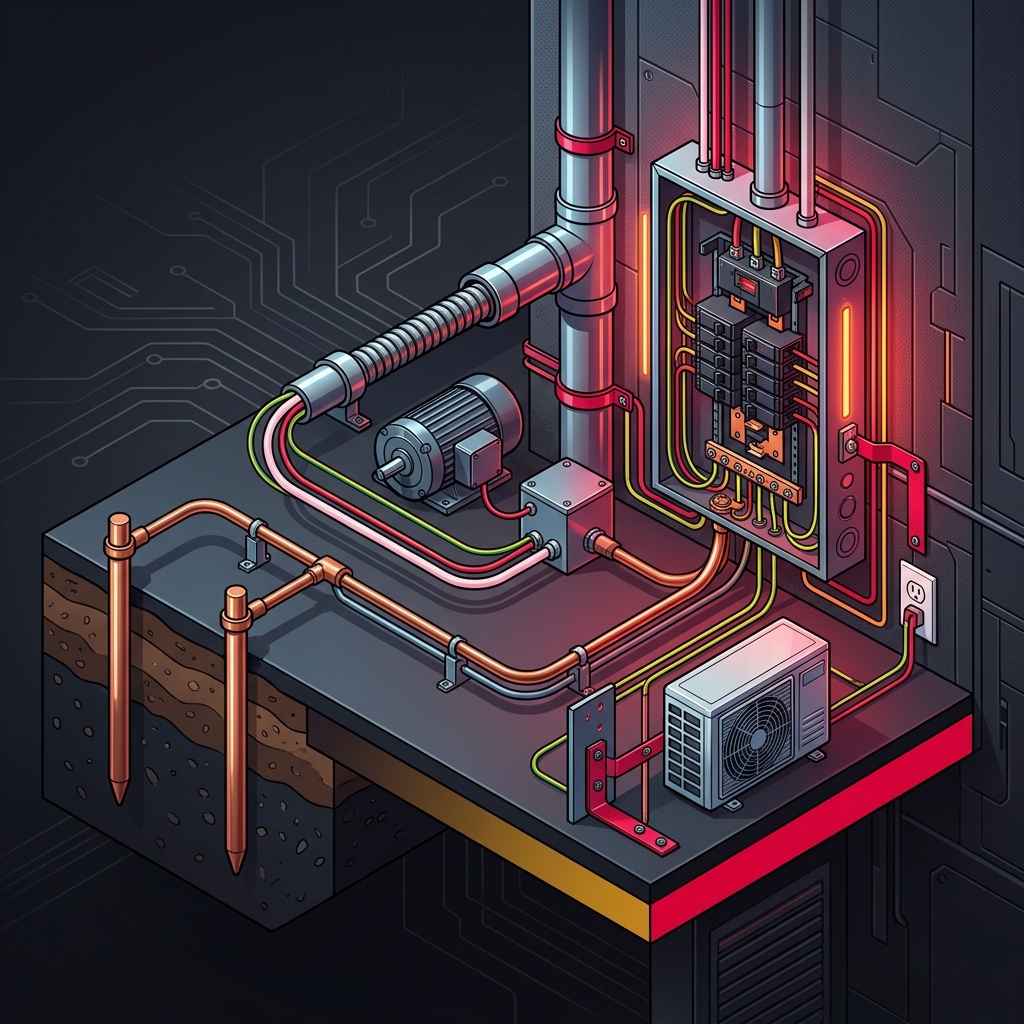
Why Equipotential Bonding Matters More Than You Think
When it comes to pool electrical work, bonding isn’t just another box to tick on an inspection checklist — it’s quite literally a life-safety system. The concept behind equipotential bonding is straightforward: bring every conductive surface in and around the pool to the same electrical potential so that no dangerous voltage differences can exist.
Here’s why this matters so much in a pool environment: while 30 volts is generally considered the threshold for danger in dry conditions, as little as 4 volts can be deadly when you’re submerged in water. That razor-thin margin is exactly why NEC Article 680 takes pool bonding so seriously, and why every electrician doing pool work needs to understand these requirements inside and out.
“If the pool pump for some reason had three volts leaking on it, we want the water to have three volts on it, we want the metal fence within so many feet to have three volts on it — so there’s no difference in potential.”
What Counts as a Permanently Installed Pool
Before diving into bonding requirements, you need to know whether your installation even qualifies. Under NEC 680.2, a permanently installed pool is defined as:
- Any constructed in-ground or partially in-ground pool (even an above-ground pool where part of the structure goes below grade)
- Any pool capable of holding more than 42 inches of water — it doesn’t need to be filled to that level
- Any pool located inside a building, even if no electricity is connected to it
That last point catches people off guard. A decorative indoor pool with zero electrical connections still falls under the full scope of Article 680.
What Must Be Bonded Under NEC 680.26
The bonding requirements in 680.26 (2017 NEC) cover five major categories. Understanding each one is essential for both exam success and field work.
1. Circulation Systems
This includes pumps, heaters, water treatment equipment, pool covers, and essentially anything integral to the pool’s operation. Most of these components will have a bonding lug built in — typically a simple threaded lug where you’ll land your #8 copper conductor.
Even if a pump is double-insulated and not required to be bonded, the code still requires you to leave a #8 whip coiled up nearby. If someone swaps that pump out for a non-insulated model down the road, the bonding conductor needs to be accessible.
2. All Fixed Metal Within 5 Feet Out and 12 Feet High
This is where the scope of pool bonding really opens up. Any fixed metal component within 5 feet horizontally from the pool edge and 12 feet vertically above the water level must be bonded into the equipotential plane. This includes:
- Ladders and railings
- Posts and fencing
- Light fixtures (both pathway lights and in-pool fixtures)
- Gutters
- Door frames
- Gas fixtures
- Metal conduit entering the bonding perimeter
“Someone were to be standing in the pool or on the pool deck and they were skimming and they had a long skimmer and it tapped a gutter — and let’s say the gutter had voltage on it, which I have seen before.”
That real-world example illustrates exactly why the 12-foot vertical requirement exists. It’s not theoretical — energised gutters, metal roofing connected to faulty equipment, and similar hazards are genuine field conditions.
3. Pool Water
Bonding the pool water itself is a requirement that wasn’t always in the code, but it’s absolutely critical. You can satisfy this requirement in one of three ways:
- A permanently installed metal ladder or railing that maintains at least 9 square inches of metal-to-water contact and cannot be removed
- A dedicated water bond fitting — a conductive fitting plumbed into the circulation system that stays in constant contact with the water
- A skimmer-mounted bonding device that connects to the water through the skimmer basket
The key requirement is that whatever method you choose, it must always remain in contact with the water — even during backwashing or routine maintenance. If the bond loses contact with the water while people are swimming, they’re effectively outside the equipotential plane in the most dangerous possible situation.
4. Surrounding Surfaces
The perimeter surfaces around the pool — concrete, earth, aggregate, or grass — must also be brought into the equipotential plane. For pools without poured concrete surroundings, this means:
- Digging a trench 4 to 6 inches below subgrade
- Running #8 copper conductor 18 to 24 inches from the pool edge
- Tapping at least 4 points for conductive pool linings and surfaces
For gunite pools where the entire bowl is one continuous rebar web, some inspectors may accept a single bond point to the rebar grid — but others will still want all four tap points. Always confirm with your inspector.
5. Metal Fittings Exception
There’s a notable exception in the code: metal fittings are not required to be bonded if they are less than 4 inches in any dimension and do not penetrate the pool structure more than 1 inch. A small metal one-hole strap holding up conduit would be a good example — imagine having to individually bond every single strap to your #8 conductor.
Methods and Fittings for Bonding
The two most common bonding methods in pool work are:
- Split bolt connectors — the most popular way to extend or tap into #8 conductors. Unscrew, slide on the existing conductor, add the new conductor, and tighten down.
- Bonding lugs — simple lug-and-screw assemblies that attach directly to metal components.
When tapping your own bonding connection into metal, you must engage at least two threads per NEC 250.8. The preferred method is to tap the hole, screw in the fitting, and add a nut on the back for a robust mechanical connection.
Every fitting you use must be:
- Listed for the application
- Rated for direct burial if installed underground
- Rated for use in concrete if embedded in concrete
“You’re only going to be there one time bonding this pool. You’re not going to be back checking on it — so we’ve got to make sure that this thing is super robust the very first time.”
Working With Your Inspector
Pool bonding is one of those areas where inspector interpretation plays a significant role. The code provides the framework, but your local inspector’s expectations on tap points, perimeter routing, and equipment-specific requirements can vary. Pull a permit on every pool installation, work side by side with your inspector, and don’t treat their involvement as a burden — they want to see you succeed.
How NEC Mastery Fits Into This
Pool bonding under Article 680 is one of the most detail-heavy topics on electrician licensing exams — and it’s exactly the kind of subject where repetition builds mastery. Understanding the interplay between 680.2 definitions, 680.26 bonding requirements, and 250.8 bonding methods requires the kind of cross-referencing that only practice can develop.
- 8,000+ exam-style questions cover Article 680, grounding and bonding, and the specific scenarios you’ll face on test day — from permanently installed pool definitions to metal fitting exceptions
- Detailed explanations referencing specific NEC articles help you build the mental connections between 680.26 bonding requirements, 250.8 methods, and the definitions in 680.2
- Timed mock exams weighted to your exam type let you practise finding pool bonding answers under pressure, building the speed you need to finish with time to spare
- No expensive course required — pair NEC Mastery with your codebook and learn through practice, not memorisation
Start Practising Today
Download the NEC Mastery app and study with 8,000+ practice questions, weighted mock exams, and detailed explanations.