MC Cable vs AC Cable: What Every Electrician Needs to Know
A clear breakdown of MC cable versus AC cable: armour construction, equipment grounding, and healthcare rules under NEC Articles 320, 330, and 517.
Understanding the Two Main Armoured Cable Types
If you’ve been in the electrical trade for any length of time, you’ve almost certainly worked with MC cable. It’s the most prominently used armoured cable product on the market today. But there’s a good chance you’ve never actually worked with — or even seen — AC cable. And understanding the difference between the two isn’t just academic trivia. It has real implications for equipment grounding, cable selection, and labour costs on the job.
Paul Qualliotine of Master The NEC — who has served on NEC Code-Making Panels 5 and 17, sat on UL and NEMA committees, and spent over 34 years in the trade — breaks down the key distinctions between these two cable types in a way that cuts straight to what matters.
AC Cable: The Original Armoured Cable
Armoured cable has been around since 1903, making it one of the oldest wiring methods still recognised in the NEC. AC cable is covered under NEC Article 320 and is manufactured to the UL 4 standard.
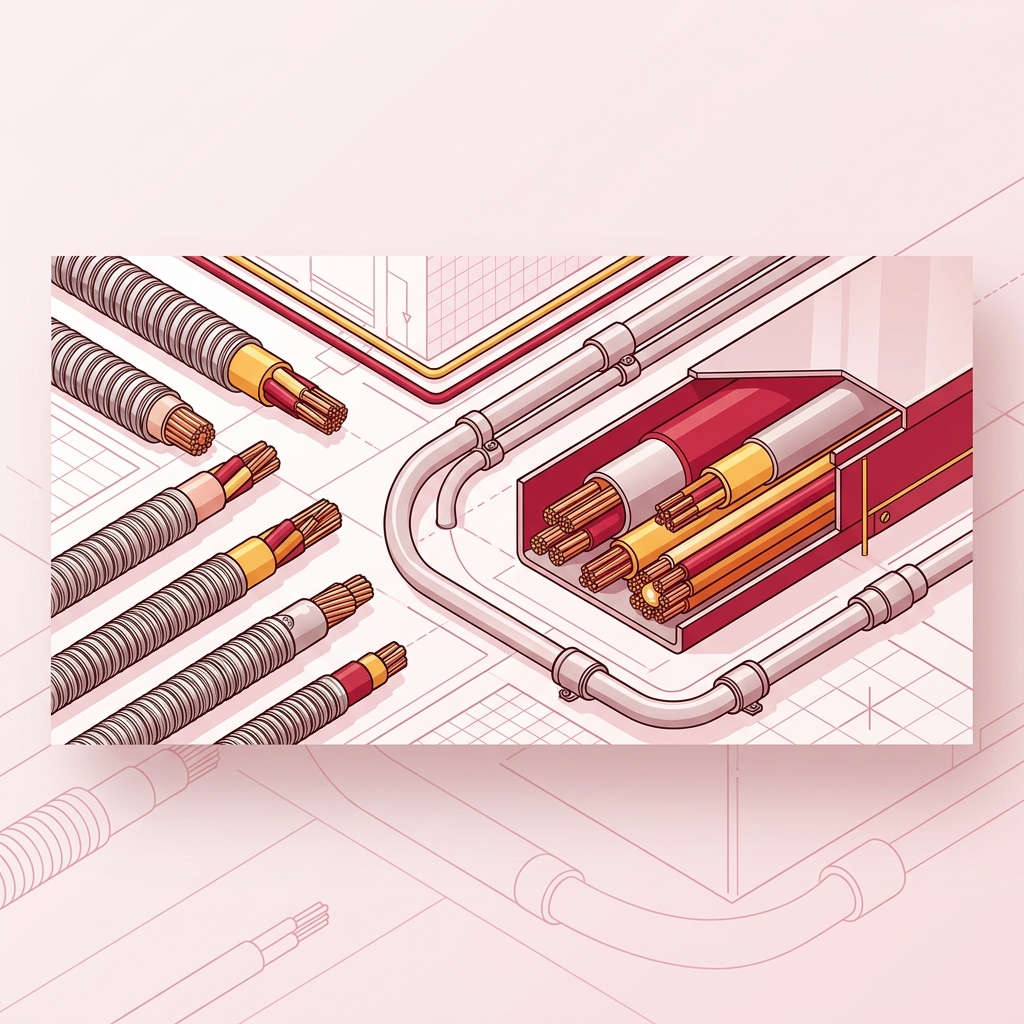
Both AC and MC cables share a similar construction at a high level: conductors are pre-plexed or twisted, run through a machine, and wrapped with an interlocking metal armour strip. A polymeric or paper wrap provides separation between the conductors and the armour. But the similarities largely end there.
Key characteristics of AC cable:
- Limited to conductor sizes 14 AWG through 1 AWG — so it’s not suitable for services or larger feeder applications
- Limited on the number of conductors inside the cable assembly
- Features distinctive brown paper wrapping around the conductor assembly
- Available in steel or aluminium armour
- Can be used anywhere MC cable is permitted
The brown paper wrapping serves an important purpose. As Paul explains, it creates a separation between the conductors and the armour, providing an extra layer of protection — particularly when you’re bending or stripping the cable and don’t want to risk damaging the insulated conductors.
The Big Difference: Equipment Grounding
Here’s where it gets interesting, and where the real distinction between AC and MC cable lives.
AC cable has a bonding strip that runs the entire length of the cable, making intimate contact with every convolution of the armour. This creates an effective low-impedance ground fault current path, which means:
“You don’t have a separate equipment grounding conductor in there. If you use a proper fitting and you connect it to the armour before you connect it to the metal box, then what you’ve got is a low impedance effective ground fault current path and you’re going to clear an overcurrent device.”
Traditional MC cable does not have this bonding strip. Because of the spiralling effect of the armour and the impedance characteristics, fault current can cancel itself out or choke — meaning it may not trip the overcurrent device. That’s why MC cable requires a separate equipment grounding conductor inside the cable assembly.
One common misconception: many electricians assume the equipment grounding conductor in MC cable must be green. It doesn’t. It can be bare or insulated — and with larger MC cable assemblies, the equipment ground is typically bare. The standard permits either.
Don’t Confuse BX With AC or MC
A persistent source of confusion in the trade is the term “BX.” Many electricians use it interchangeably with AC cable, but they are not the same thing.
“BX was an experimental product by General Electric… it was never intended for that armour in BX to be used as an equipment ground. In fact, it predates when equipment grounds started being required.”
BX actually more closely resembles MC cable in the sense that its armour cannot be used as an equipment grounding conductor. The bonding strip and associated advancements came later. So if you’re working in an older building with what someone calls “BX,” don’t assume the armour provides an effective ground fault current path — it almost certainly doesn’t.
MC Cable: No Size or Conductor Limits
MC cable, covered under NEC Article 330 and manufactured to the UL 1569 standard, removes the size and conductor limitations that restrict AC cable:
- No limit on conductor size — you can get MC cable with conductors of 1000 kcmil or larger
- No limit on the number of conductors — the only practical limitation is the ampacity adjustment required when you have multiple current-carrying conductors in a single cable assembly
- Suitable for services, feeders, and branch circuits
This flexibility is what makes MC cable the dominant armoured cable product in modern electrical work.
MC-IA: The Advanced Option
Here’s where the product lines start to converge. Manufacturers produce an advanced MC cable designated MC-IA (sometimes called “MC-I-A”), where the “A” stands for advanced — or, as Paul suggests, think of it as “A for armour being used as an effective ground fault current path.”
MC-IA includes an aluminium bonding conductor (typically 8 AWG or 10 AWG depending on cable size) that makes intimate contact with the armour convolutions, similar to the bonding strip in AC cable. This allows the armour itself to serve as an equipment grounding path — something traditional MC cannot do.
Why would you pay more for MC-IA? Labour savings. When the armour qualifies as an equipment ground path, you eliminate pigtails and reduce connections when going from armour to connector to metal box.
Healthcare Facility Cables (HCF)
One of the most misunderstood aspects of armoured cable is the HCF designation. As Paul makes clear:
“Everybody thinks that HCF is a listing — it’s not.”
HCF refers to cable assemblies that meet the redundant ground fault current path requirements of NEC 517.13(A) and (B) for patient care spaces. Both AC and MC cable can be constructed to meet these requirements. Here’s how:
AC cable to HCF:
- The armour already serves as one ground fault current path
- Add an insulated equipment grounding conductor inside the assembly
- Now you have two paths — HCF requirements met
MC cable to HCF:
- Upgrade to MC-IA (add the bonding conductor so the armour qualifies as a path)
- The insulated equipment grounding conductor already present provides the second path
- Two paths — HCF requirements met
It all comes down to ensuring those two redundant paths exist, which is the core requirement of 517.13.
Choosing the Right Cable for the Job
| Feature | AC Cable | MC Cable | MC-IA Cable |
|---|---|---|---|
| NEC Article | 320 | 330 | 330 |
| UL Standard | UL 4 | UL 1569 | UL 1569 |
| Max Conductor Size | 1 AWG | No limit | No limit |
| Conductor Count Limit | Yes | No | No |
| Armour as EGC | Yes | No | Yes |
| Separate EGC Required | No | Yes | Yes (already included) |
| HCF Capable | Yes (add insulated EGC) | Yes (upgrade to MC-IA) | Yes (with insulated EGC) |
How NEC Mastery Fits Into This Strategy
Understanding the distinctions between AC cable, MC cable, and MC-IA isn’t just useful on the job — it’s the kind of knowledge that shows up on journeyman and master electrician exams. Questions about wiring methods, equipment grounding requirements, and healthcare facility installations are staples of every exam, and knowing the nuances covered in Articles 320, 330, and 517 can be the difference between a pass and a fail.
- 8,000+ exam-style questions cover wiring methods including AC cable, MC cable, and their healthcare facility applications — so you’ll see these distinctions tested from every angle
- Detailed explanations referencing specific NEC articles help you build a deep understanding of why the armour qualifies as an equipment ground in some cables and not others, reinforcing the code logic behind each product
- Timed mock exams weighted to your exam type let you practise identifying the correct cable type for a given installation scenario under real time pressure
- Whether you’re studying for the journeyman or master exam, NEC Mastery pairs directly with your codebook to turn product knowledge like this into exam-day confidence
Start Practising Today
Download the NEC Mastery app and study with 8,000+ practice questions, weighted mock exams, and detailed explanations.